
Synopsis
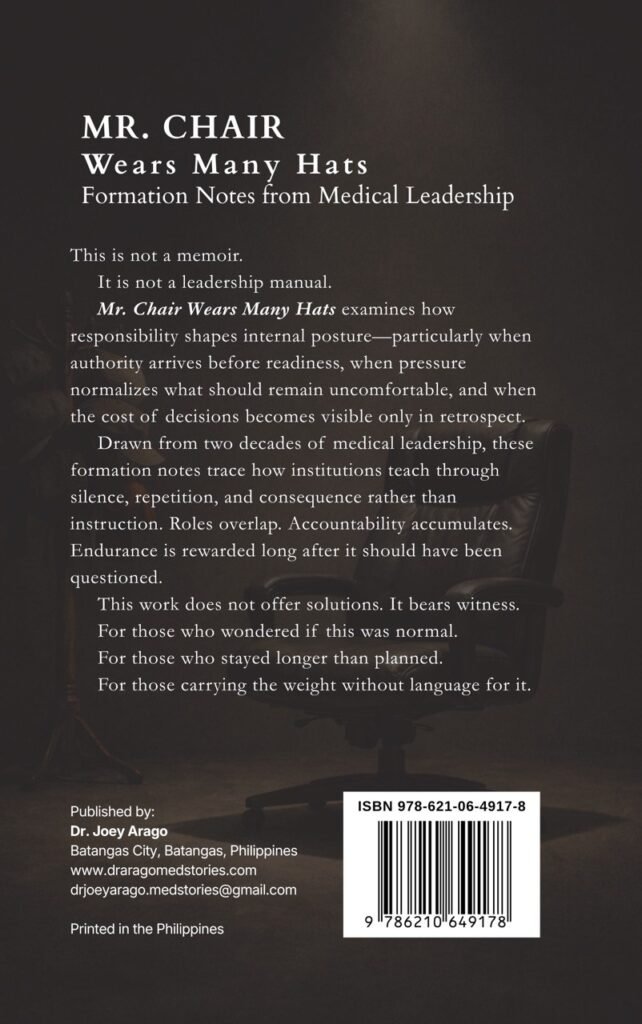
Mr. Chair Wears Many Hats examines how institutional responsibility shapes internal posture when authority arrives before readiness. Dr. Jose Apollo J. Arago reflects on two decades of medical leadership across multiple roles—department chair, medical administrator, board member, committee leader, educator, editorial reviewer—documenting how the accumulation of authority changes the person who carries it.
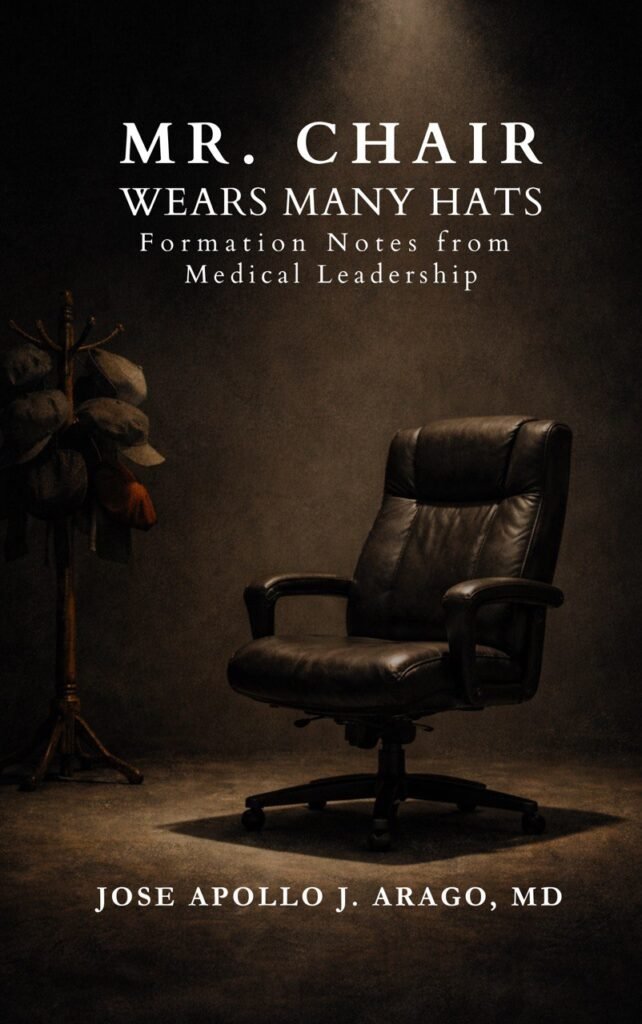
The book is structured in four Acts that trace shifts in responsibility rather than chronological progression. Act I, “Authority Before Readiness,” explores what happens when leadership titles are conferred without adequate preparation. Dr. Arago describes assuming the role of department chair under circumstances that made refusal difficult, navigating institutional expectations while learning the responsibilities in real time. He examines “borrowed authority”—the exercise of power derived from position rather than earned through mastery—and the way institutional systems depend on individuals accepting roles they are not yet equipped to manage.
Act II, “The Accumulation,” addresses what occurs when roles multiply without corresponding support. The author describes serving simultaneously as clinician, chair, administrator, and committee member, managing competing obligations that fragment attention and erode boundaries. He recounts the normalization of overextension: accepting additional responsibilities not because resources permit but because refusal seems impossible or disloyal. This section traces the quiet cost of saying yes repeatedly—the erosion of clinical focus, the compression of family time, the replacement of reflection with reaction.
Act III, “The Cost of Staying,” confronts what remains after prolonged institutional service. Dr. Arago reflects on moments when administrative pressure conflicted with clinical judgment, when institutional priorities required silence about harms that could have been prevented, and when loyalty to the system meant absorbing consequences that originated elsewhere. He describes inheriting accountability for decisions made before his tenure, responding to audit findings that named him as chair without distinguishing between his authority and structural problems embedded in the institution long before his arrival. This section examines the residue that accumulates when responsibility settles unevenly—when those who remain carry the consequences of what those who left behind.
Act IV, “What Formation Leaves,” turns toward the question of posture. The author does not claim resolution but describes what changed through sustained exposure to institutional pressure: heightened awareness of when endurance substitutes for discernment, clearer recognition of when to refuse additional roles, and the capacity to name cost earlier before it becomes irrecoverable. He reflects on his decision not to pursue further subspecialty credentials after completing fellowship training, describing this restraint not as withdrawal but as stewardship—a refusal to accumulate identities that would further fragment already divided attention.
Throughout, Dr. Arago integrates scriptural reflection not to explain leadership but to place it under examination. He does not offer prescriptive solutions or leadership principles but witnesses to how systems form those within them. The book addresses what happens when good people operate within structures that normalize harm, when silence becomes a professional expectation, and when the person carrying authority must decide whether to absorb pressure or redistribute it.
The tone is deliberate, spare, and undefensive. The author does not justify decisions or seek vindication but names what occurred and what it required. He acknowledges that others involved in the same institutions and moments may remember them differently, and he frames his reflections as partial testimony rather than definitive account.
Mr. Chair Wears Many Hats is written for those navigating institutional responsibility in healthcare: department chairs, medical administrators, committee leaders, and educators who inherited authority they did not seek and are learning to carry it carefully. It is for those wondering whether what they are experiencing is normal, those who have forgotten what they loved before the roles accumulated, and those who survived but need language for the cost. The book does not teach; it witnesses. It offers not lessons to extract but a mirror in which readers may recognize their own formation still in progress.
No responses yet