Synopsis
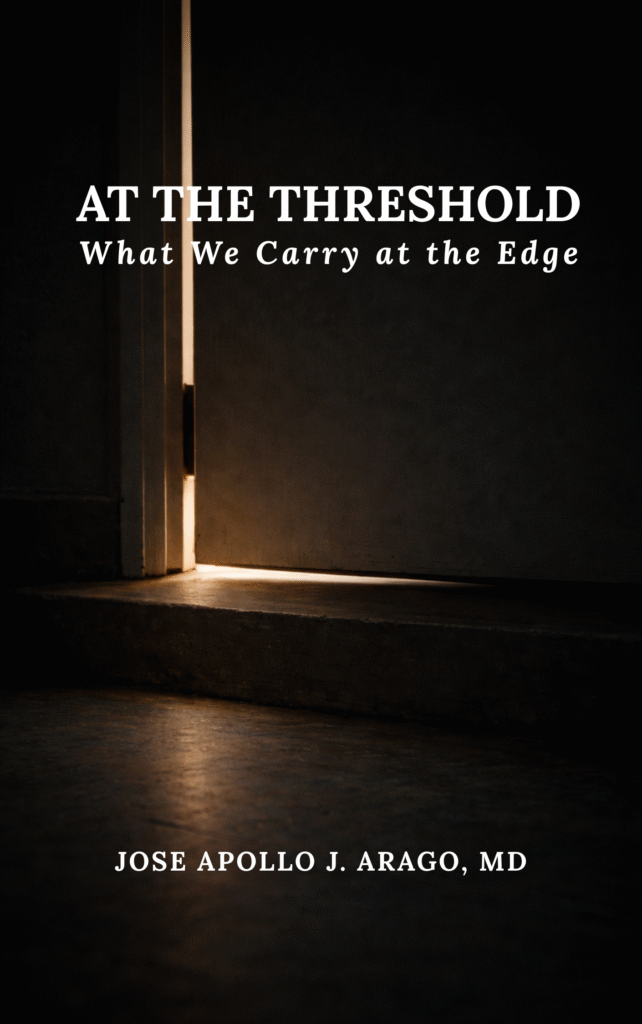
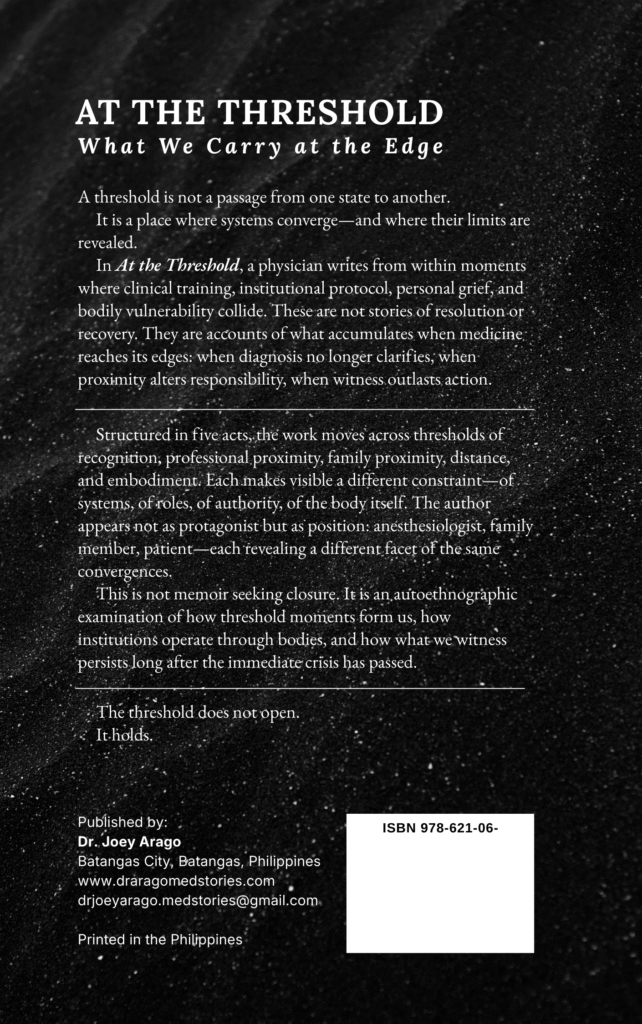
At the Threshold examines moments when professional expertise, personal grief, and institutional constraints converge at the edge of what medicine can manage. Dr. Jose Apollo J. Arago documents encounters with serious illness and mortality from multiple positions—as anesthesiologist, brother, son, and administrator—tracing how proximity to death shapes clinical judgment, professional identity, and the body that carries both.
The book is organized in five Acts and a Coda that move through different forms of proximity to threshold moments. Act I, “Recognition,” opens with the author’s clinical encounters with patients facing terminal diagnoses. He describes the work of providing anesthesia for cancer surgeries, noticing what bodies signal before pathology confirms it, and the professional restraint required when clinical knowledge reveals what families do not yet understand. These chapters establish the tension between what physicians recognize early and what they can or should articulate.
Act II, “Professional Proximity,” follows colleagues navigating illness. The author recounts caring for fellow healthcare workers who move from providers to patients, describing the collapse of professional distance when the person on the operating table is someone you have worked alongside. He examines what changes when clinical relationships become personal, when chart reviews require reading the medical history of someone whose voice you recognize, and when professional boundaries offer no protection from the weight of what you know.
Act III, “Family Proximity,” documents the author’s experience as his sister-in-law undergoes treatment for cancer. He describes accompanying her through diagnosis, surgery, chemotherapy, and the progression of disease despite aggressive intervention. These chapters trace the convergence of his roles as physician and brother—providing anesthesia for her procedures, interpreting medical information for the family, navigating the healthcare system on her behalf while simultaneously inhabiting it as a patient’s relative. The author does not resolve the tension between clinical knowledge and familial helplessness but witnesses to its accumulation.
Act IV, “Witness from Distance,” addresses care at the end of life. The author reflects on what the request for assisted dying represented—a convergence of pastoral care, medical capability, legal constraint, and personal relationship that could not be reconciled within any single framework. He describes witnessing suffering he could recognize medically but could not relieve within the boundaries of his practice and the law.
Act V, “Embodied Thresholds,” turns to the author’s own stroke in February 2018, four months after his older brother and his son were murdered. The author traces the accumulation of grief, professional pressure, and ignored physical warnings that preceded his collapse. He describes the experience of becoming a patient in the hospital where he worked, the disorientation of clinical knowledge confronting personal vulnerability, and the slow recognition that some thresholds are crossed not by choice but by the body’s refusal to continue under accumulated weight.
The Coda, “Rupture,” returns to October 3, 2017—the day of the murders. These chapters describe the convergence of violent loss with professional responsibility, the impossibility of performing competence while breaking internally, and the physical collapse that eventually forced what he would not choose.
Throughout, the book employs sparse, precise prose of witness. Dr. Arago does not offer clinical distance or emotional resolution. He describes what occurred at each threshold—the clinical details, the institutional constraints, the personal weight—without claiming mastery over any of it. The tone is deliberate and undefensive. The structure resists narrative closure, reflecting the author’s argument that thresholds do not resolve but accumulate, becoming what those who witness them continue to carry.
At the Threshold is written for healthcare providers who have stood at the edges of what medicine can manage, family members navigating serious illness in loved ones, and anyone confronting the inadequacy of professional frameworks when personal loss intrudes. Instead of offering guidance or consolation, it bears witness to the irreducibility of threshold moments—the way they resist simplification, the weight they leave behind, and what it requires to continue practicing after standing at edges you cannot step back from.
No responses yet