Synopsis
Breaking Point is a physician’s memoir that examines what happens when the body that carries a vocation suddenly fails. Dr. Jose Apollo J. Arago, an anesthesiologist working in the Philippines, traces his journey from professional competence through physical collapse to a reconstruction of identity rooted in grace rather than performance.
The book is structured in four parts that move chronologically through crisis and recovery. Part I, “The Shattering,” establishes the rhythm of Dr. Arago’s life before the stroke: the long hours in operating rooms, the careful calibration of medications and vital signs, the quiet accumulation of fatigue normalized as duty.
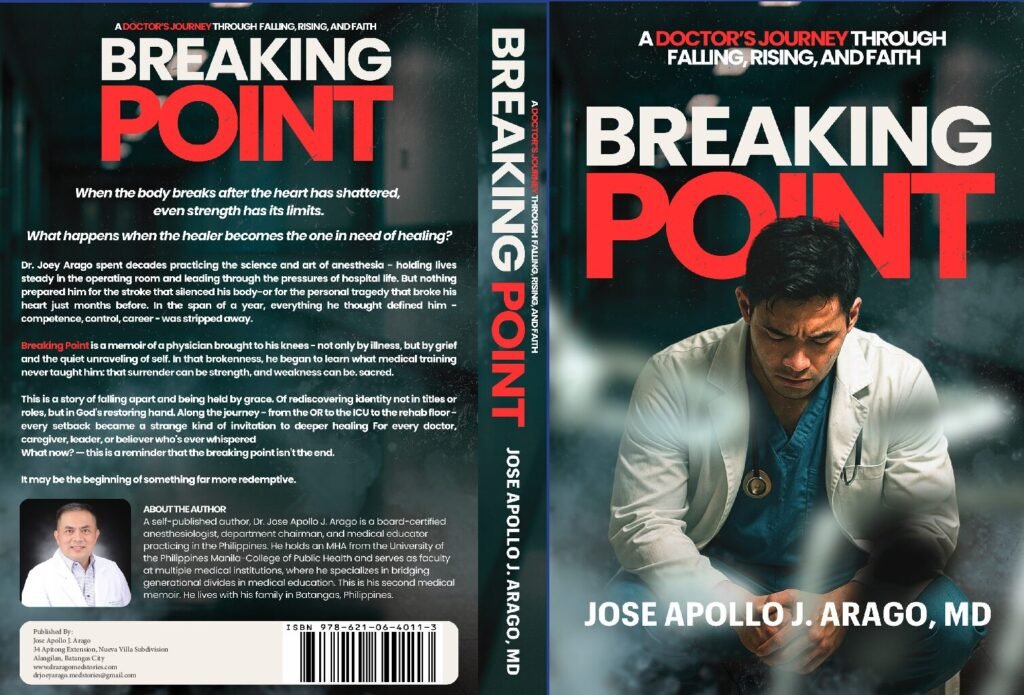
This section includes the sudden, violent death of his older brother Dom and his son Denn, a trauma that destabilizes him even as he continues working. The author describes the body’s warnings—numbness, exhaustion, physical symptoms he recognized medically but dismissed personally—that culminated in a stroke that left him partially paralyzed.
Part II, “The Recovery,” focuses on the immediate aftermath: hospitalization, the fear and disorientation of being a patient rather than a physician, and the slow, uncertain process of physical rehabilitation. Central to this section is the presence of his wife Bibian, whose quiet faithfulness becomes a thread of continuity when everything else has unraveled. The author recounts the intimate indignities of dependence, the frustration of a mind that remembers what the body can no longer do, and the spiritual reckoning that occurs when performance-based identity collapses.
Part III, “The Formation,” steps back to examine the foundational beliefs and systems that led to the breaking point. Dr. Arago reflects on his medical training, the cultural and professional pressures that shaped his sense of worth, and the mentors and failures that clarified—or complicated—his understanding of vocation. This section interrogates the cracks in a framework built on endurance and self-sufficiency.
Part IV, “The Becoming,” follows the author’s return to work and ministry during the COVID-19 pandemic, a period that reactivated earlier grief while also clarifying a new sense of calling. Dr. Arago describes leading a hospital department while still recovering, navigating professional responsibilities alongside spiritual formation, and learning to testify not to his own strength but to the grace that sustained him through collapse. The epilogue, “Broken and Remade,” frames the entire journey as one of recommissioning—not a restoration of the old self, but the formation of something fundamentally different.
Throughout, the author writes with clinical precision and spiritual candor. He does not romanticize suffering or offer tidy resolutions. Instead, he presents the breaking point as a threshold where illusions of control are shattered and a different kind of strength—one rooted in dependence and surrender—becomes possible.
Breaking Point is for readers navigating their own thresholds: physicians and caregivers confronting burnout, individuals rebuilding after loss, and anyone asking what remains when the identity they have built can no longer be sustained. It offers not a blueprint for recovery, but a witness to the possibility of grace in the stillness after collapse.
No responses yet