Synopsis
What They (Never) Taught Us examines the unspoken education that shapes every physician—the lessons learned not from textbooks or lectures, but from silence, failure, and the grinding reality of clinical training. Dr. Jose Apollo J. Arago chronicles his journey through medical school, internship, and anesthesiology residency in the Philippines, revealing how institutional culture, financial pressure, and the demands of clinical competence form identity as powerfully as any formal curriculum.
Organized around Dr. Arago’s progression through medical training, his second medical memoir begins with his decision to enter medicine and moving through increasingly complex stages of responsibility. Early chapters establish the weight of family expectation in Filipino culture, where a child’s medical education often represents an entire extended family’s investment in social mobility. Dr. Arago describes the financial strain of tuition, the sacrifices required to stay enrolled, and the early recognition that becoming a doctor involves costs that are not solely monetary.
The narrative follows his internship and early residency, where he encounters the gap between classroom knowledge and clinical reality. He recounts procedures attempted without adequate preparation, moments of diagnostic uncertainty, and the informal hierarchy that determines who receives mentorship and who is left to improvise.
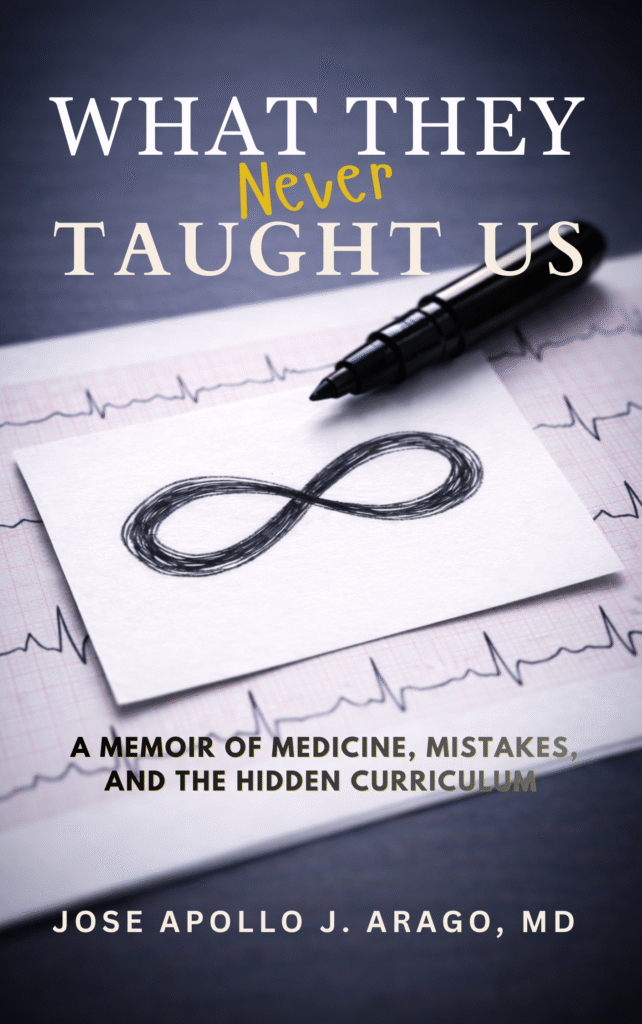
The book details specific clinical incidents where the absence of explicit guidance forced him to navigate by instinct, observation, and improvisation. These stories are interwoven with reflections on what the author calls the “hidden curriculum”: the unwritten rules about endurance, the expectation of silence around mistakes, and the cultural norms that reward stoicism over vulnerability.
Throughout, the memoir is threaded with F.A.C.T.S.—five recurring themes that surface across training: Failure and Fear, Awareness, Consequence, Tools and Technique, and Sharing (of story, struggle, and self). These themes structure the author’s reflections and provide a framework for understanding how experiences accumulate into professional identity.
Dr. Arago also tackles the financial dimensions of medical training with unusual directness. He describes the tension between the ideals of service and the need for financial survival, the pressure to accept any work to offset educational debt, and how financial anxiety shapes career decisions and personal relationships. Practical concerns are presented s central forces that influence how young physicians move through their training and into practice.
The later sections, the book focuses on moments of crisis and clarification: cases that went wrong, conflicts with colleagues, periods of exhaustion that approached collapse, and the gradual development of clinical judgment through accumulated error and correction. The author does not present himself as having resolved these tensions, but as someone still navigating the distance between the physician he was trained to be and the person he is becoming.
Turning toward the question of what is passed on, the author reflects on his role as an educator and the responsibility to make visible what previous generations left unspoken. He argues that the hidden curriculum does not have to remain in that state—that naming its patterns and costs is a necessary step toward forming physicians who are clinically competent and psychologically whole.
What They (Never) Taught Us is written for physicians, medical trainees, and students, particularly those in the Philippines, but also for anyone in professions that reward silence over honesty and endurance over well-being. It does not solutions but language—a way to name the experiences that shape medical training and the possibility of doing better by those who follow.
No responses yet