Welcome to Dr. Joey Arago Med Stories
Thirty years.
That’s how long this drawing sat tucked away in my old files, forgotten among medical textbooks and faded certificates. When I stumbled upon it recently while cleaning out storage boxes, I felt like an archaeologist discovering ancient hieroglyphs—except these hieroglyphs told the story of my medical training, drawn with the raw immediacy of someone who had just lived through it.
May 1, 1995. One week after finishing my postgraduate internship at Batangas Regional Hospital. Three months before the August 1995 Physician Licensure Examination. This is the story of an illustration that became a time capsule.
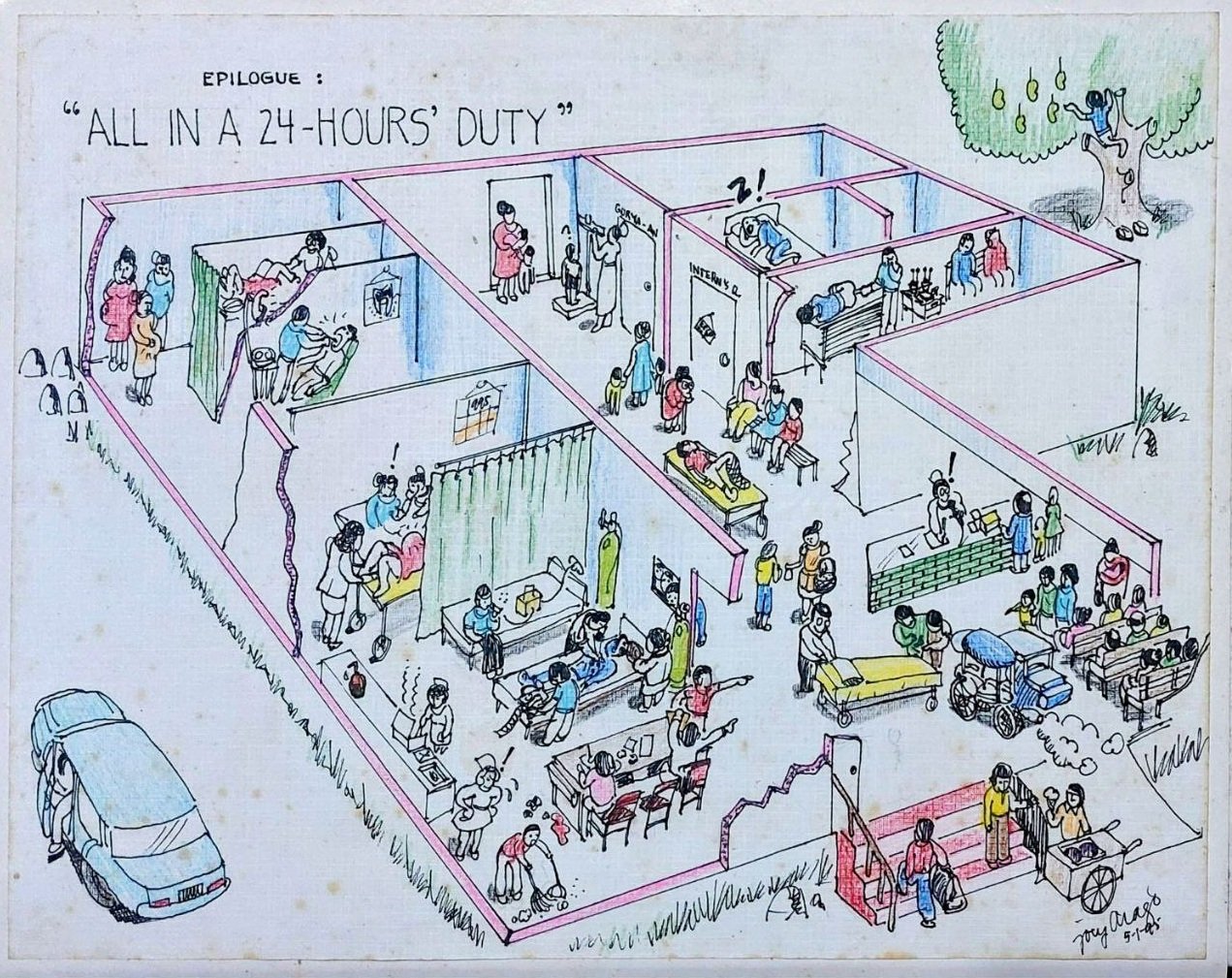
Epilogue: All in a 24-Hours’ Duty (May 1, 1995)
Crayon pencil on watercolor paper, 8.27 × 11.69 in (A4)
Drawn a week after completing my postgraduate internship at Batangas Regional Hospital, this piece captures the intensity and exhaustion of a single duty that seemed to compress a lifetime of learning into twenty-four hours. It stands as both a record of that season and a closing note to one of the most formative years of my medical journey.
The Drawing That Started It All
“ALL IN A 24-HOURS’ DUTY” reads the title, scrawled across the top in my younger self’s handwriting. Inspired by Larry Alcala’s iconic “A Slice of Life” illustrations, I had attempted to capture the organized chaos of a busy government referral hospital in a single frame. What I didn’t realize then was that I was creating a historical document—a snapshot of Filipino medical training in the mid-1990s that would feel both familiar and foreign to today’s medical students.
Why This Matters Now
As I looked at this drawing again, I realized something profound: while medical technology has leaped forward by decades, the human experience of medical training remains remarkably constant. The exhaustion in the resident’s eyes, the mix of anxiety and determination in medical students, the way families cluster in waiting areas hoping for good news—these elements transcend time.
But there are differences too. Big ones. And those differences tell a story worth preserving.
A Hospital Frozen in Time
In 1995, Batangas Regional Hospital was a bustling 250-bed government facility serving as the apex referral center for the CALABARZON region. It was where medical graduates like myself completed our mandatory one-year postgraduate internship—a rite of passage that shaped an entire generation of Filipino physicians.
- The emergency room where we learned to think fast and act faster
- The medical wards where rounds felt like military formations
- The operating theaters where we first held beating hearts
- The outpatient areas where we learned that medicine is as much about listening as examining
Each space holds dozens of stories. Stories of triumph, heartbreak, learning, and growth. Stories that current medical students and residents might recognize in their own experiences, despite the thirty-year gap.
The Pre-Digital Era
What’s not there. No automated bedside patient monitors. No computers at bedside. No electronic medical records. No smartphones buzzing with updates. Communication happened face-to-face, through handwritten notes, and via the hospital’s aging paging system.
We carried physical charts from room to room. Lab results were written on paper and physically delivered. X-rays were actual films held up to light boxes. When we needed to look something up, we opened textbooks—actual, physical textbooks.
Yet somehow, we managed to provide excellent patient care. How? Through mentorship, observation, and the kind of deep, focused attention that perhaps comes easier when you’re not managing multiple digital inputs simultaneously.
The Constant Elements
But beneath the technological differences, the core experiences remain unchanged:
The First Code Blue: That moment when the emergency bell rings and your heart simultaneously races and stops, knowing that someone’s life hangs in the balance and you’re part of the team trying to save it.
The Difficult Diagnosis: Staying up all night reading textbooks, searching for that one syndrome that explains your patient’s puzzling symptoms.
The Mentor’s Teaching: Those attending physicians who took time to explain not just what to do, but why—shaping not just our medical knowledge but our approach to patient care.
The Camaraderie: Those bonds forged during 36-hour shifts, sharing instant coffee at 3 AM while discussing cases and dreams for the future.
The Weight of Responsibility: That sobering moment when you realize that your decisions directly impact human lives.
Why I’m Sharing This Now
Thirty years later, I’m an anesthesiologist, a medical educator, an author with three decades of patient care behind me. I’ve watched medicine evolve dramatically—some changes for the better, others perhaps not. But what I’ve learned is that every generation of medical professionals thinks they’re facing unprecedented challenges, unprecedented stress, unprecedented changes.
The truth is, medical training has always been demanding. It has always required sacrifices. It has always pushed young minds and bodies to their limits. And it has always, ultimately, been worth it.
Building Bridges Across Generations
This blog exists to build bridges. Between the doctor I was in 1995 and who I am now. Between my generation’s training experience and what today’s medical students face. Between the universal truths of medical education and the specific changes each era brings.
I want to hear from you—current medical students, residents, young attendings. How does your experience compare? What challenges do you face that we couldn’t have imagined? What aspects of training remain frustratingly unchanged?
And to my fellow veterans—those who trained in the ’80s, ’90s, and 2000s—I invite you to share your own stories, your own illustrations (literal or metaphorical) of what medical training looked like in your era.
What’s Coming Next
In future posts, I’ll take you room by room through this illustration, sharing specific stories and memories from each area. I’ll explore how different aspects of medical training have evolved, invite guest contributors to share their perspectives, and hopefully create a space where medical professionals across generations can connect and learn from each other.
Because while the tools of medicine may change, the heart of medicine—caring for fellow human beings during their most vulnerable moments—remains eternal.
Your Stories Matter Too
This illustration is just one person’s perspective from one moment in medical history. I want to collect more perspectives, more moments, more stories. If you have drawings, photos, or memories from your medical training—whether from 1975 or 2025—I’d love to feature them here.
After all, every doctor has stories. And every story matters.
Next week: “Room by Room: The Emergency Department – Where Every Second Counts”
Like what you’re reading?
Subscribe below to get my next posts straight to your inbox.
One response
It was a fun read, Doc! Really love your illustrations, more to come 👏